Each Way Bets Explained | How To Calculate EW Winnings

What Is an Each Way Bet?

An Each Way (EW) bet is bet a type commonly available in horse racing, and also other sports such as golf or tennis. It is essentially two bets in one: one bet is for the horse (or player) to win, and the other bet is for the horse (or player) to place.

The “place” portion of the bet pays out if the horse (or player) finishes in the top two, three, or four places depending on the size of the field and the specific rules of the bet. The payout for the “place” portion of the bet is a fraction of the win payout, determined by the odds and the number of places being paid out.

The outcome of your Each Way bet depends on where the horse came in the race. There’s three potential outcomes:

  1. Win: If the horse comes 1st, you win both the ‘Win’ and ‘Place’ parts of your Each Way bet.
  2. Placed: If the horse finishes in the designated places (e.g., top 2, 3, or 4), you win the ‘Place’ part but lose the ‘Win’ part of your bet.
  3. Unplaced: If the horse fails to place, you lose both the ‘Win’ and ‘Place’ parts of your bet.

EW betting is particularly popular in unpredictable races like the Grand National, where predicting the outright winner is challenging. The advantages of Each Way bets include higher strike rates and more consistent results, making them suitable for a low-risk betting strategy.

Example

Imagine you place a £10 Each Way bet on a horse with odds of 10/1.

This means you’re effectively placing two separate £10 bets: one for the horse to win and another for it to place, making your total stake £20.

Here’s how it works:

  • If the horse wins the race, you receive payouts for both the win and place bets.
  • If the horse finishes in one of the designated place positions (e.g., top 2, 3, or 4 depending on the race and bookmaker), you receive a payout for the place bet. This payout is typically a fraction of the win payout.
  • If the horse neither wins nor places, both the win and place bets lose.

It’s crucial to note the place terms specified by the bookmaker. These terms determine how much you’ll receive for the place part of your bet. I’ll provide detailed explanations in the following sections.

Each Way Place Terms Explained

The place terms are determined by the Bookmaker or Betting Exchange where you place your Each Way (EW) bet, typically found on or near the bet slip.

There are two key components to understand about Each Way place terms:

  • Places Paid: This specifies the number of positions that qualify for the ‘Place’ part of the bet.
  • Place Fraction: This is the fraction of the win odds used to calculate the payout for the ‘Place’ bet.

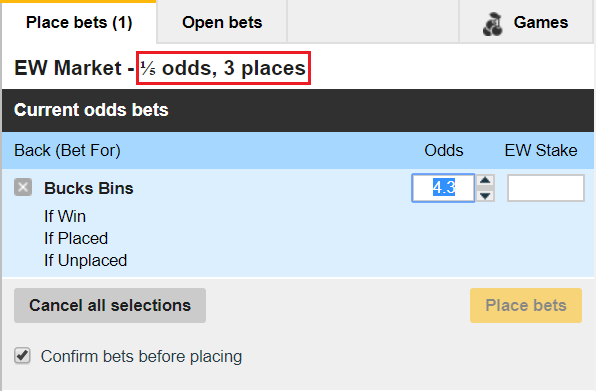
For example, if the place terms state: “This EW market pays 1st-3rd in the race at 1/5 odds,” it means:

  • You can win the ‘Place’ bet if your selection finishes in the top 3.
  • The payout for the ‘Place’ bet will be calculated at 1/5 of the win odds.

An EW market Paying 1st-3rd in the race at 1/5 odds
Each Way Bets Explained — How To Calculate EW Winnings


To determine your potential winnings from an Each Way bet, you can use an Each Way Bet Calculator by inputting the odds, stake and place terms. For a detailed step-by-step calculation example, continue to the section ‘How to Calculate Each Way Payouts’ below.

When Is Each Way Betting Worth Considering?

Each Way betting is often most attractive when a selection has a realistic chance of finishing near the front of the field but is not necessarily expected to win outright. Here are some situations where bettors commonly consider Each Way bets:

  1. Large Handicap Races. Predicting the winner can be difficult in large, competitive fields, making the place portion of an Each Way bet more appealing.
  2. Big-Priced Selections. Outsiders can still provide a return if they finish in the places, even when winning looks unlikely.
  3. Competitive Races. Each Way betting can reduce some of the risk when several runners appear to have similar chances.
  4. Major Racing Festivals. Events such as Cheltenham, Royal Ascot, and the Grand National often feature enhanced place terms and extra-place promotions.

Where Can You Find Value With Each Way Betting?

Unlike many other bet types, the bookmaker or betting exchange you use can have a significant impact on the value of an Each Way bet.

Best Odds Guaranteed (BOG)

Many UK bookmakers offer Best Odds Guaranteed on horse racing. This means that if you take an early price and the Starting Price (SP) is higher, your bet will be settled at the bigger odds.

For Each Way bettors, this can be particularly valuable because both the win and place portions of the bet benefit from the improved price. However, it is important to check the terms and conditions, as some promotions and special markets may not qualify for BOG.

Extra Place Promotions

Many bookmakers regularly offer additional places on selected races, particularly during major meetings such as Cheltenham, Royal Ascot, and the Grand National.

For example, a race that would normally pay the first four places may instead pay five, six, or even more places. While the odds may sometimes be adjusted slightly, these promotions can increase the chances of collecting a return from the place portion of an Each Way bet.

Betting Exchanges

Betting exchanges provide an alternative approach to finding value. While exchanges do not typically offer Best Odds Guaranteed or extra-place promotions, they may offer stronger outright prices than traditional bookmakers.

Some bettors compare bookmaker prices, place terms, and exchange odds before placing their bets, particularly in large handicaps where small differences in value can have a meaningful impact over time.

Matchbook

Low commission

Betdaq

Betfair alternative

Smarkets

Modern exchange

Comparing Your Options

There is no single best place to make every Each Way bet. In some races, a bookmaker’s Best Odds Guaranteed offer or extra-place promotion may provide the best value. In others, the prices available on a betting exchange may be more attractive.

Many experienced horse racing bettors compare bookmaker prices, place terms, and exchange odds before placing their bets, rather than automatically using the same operator for every race.

How to Calculate Each Way Payouts

Now, let’s walk through the manual calculation of Each Way profits using both Fractional and Decimal odds, without relying on an online calculator.

Imagine you’ve placed an Each Way bet of £10 (£5 on Win and £5 on Place) on a horse priced at 20/1 (21.0 decimal odds). The Each Way terms for the race are:

  • 6 places at 1/5 of the odds.

Here are the three potential outcomes of this EW bet:

1. Race Winner

Here are the results of the win and place bets when the horse wins the race:


Win bet:

  • Fractional: £5 x (20/1) = £100 + £5 stake back = £105 return
  • Decimal: £5 x (21.0 -1) = £100 + £5 stake back = £105 return

Place bet:

  • Fractional: £5 x (20/5) = £5 x (4) = £20 + £5 stake back = £25 return
  • Decimal: £5 x ((21.0 -1)/4) = £20 + £5 stake back = £25 return

Total Return = £105 (Win) + £25 (Place) = £130

Total Profit = £130 (Total Return) – £10 (Total Risk) = +£120

2. Placed

Here are the results of the win and place bets when the horse places but doesn’t win (i.e. it finishes 2nd-6th):


Win bet:

  • Fractional & decimal: £0 return

Place bet:

  • Fractional: £5 x (20/5) = £5 x (4) = £20 + £5 stake back = £25 return
  • Decimal: £5 x ((21.0 -1)/4) = £20 + £5 stake back = £25 return

Total Return = £0 (Win) + £25 (Place) = £25

Total Profit = £25 (Total Return) – £10 (Total Risk) = +£15

3. Unplaced

Here are the results of the win and place bets when the horse does not place in the race (i.e. it finishes 7th or lower):


Win bet:

  • Fractional & decimal: £0 return

Place bet:

  • Fractional & decimal: £0 return

Total Return = £0

Total Profit = -£5 (Win) + -£5 (Place) = –£10


Remember: you can simply use an online Each Way Bet Calculator.

How Do Dead Heats Impact Each Way Bets?

Determining the winner of a race often involves a photo finish. However, when the result is too close to call and results in a “Dead Heat,” it means there is a tie between one or more horses.

Each Way bets handle Dead Heats in the same manner as other bet types. The stake is divided among the number of winners in the event.

For instance, in a two-way Dead Heat (where 2 horses tie for the win), the return and profit would be half of what they would have been if the horse had won outright. In the example above, the bet would return £77.50 with a profit of £67.50.

Alternatives to Each Way Betting

While the traditional Each Way bet remains the most popular way to back horses beyond the outright win, many bookmakers now provide creative alternatives that reward finishing position in different ways.

Position Payout Markets

Bet365 has introduced Position Payout, a market that rewards you based on where your horse finishes. The higher the finishing position, the greater the payout. This market is available pre-race on selected meetings across the UK, Ireland, Australia, New Zealand, and international racing. Free bet rewards are credited within 48 hours of settlement, subject to terms and conditions.

Extra Places

One of the most common alternatives to standard Each Way betting is Extra Places. Many bookmakers extend the number of places they pay out on major meetings — for example, paying on 5 or 6 places instead of the usual 4. This gives bettors more opportunities to collect on their Each Way bets.

Betting Without the Favourite

Another popular option is the Betting Without market, where the favourite is removed from the betting. Prices are adjusted accordingly, and returns are settled as if the favourite wasn’t running. This can appeal in races where one horse is strongly expected to dominate.

Insurance Specials

Some bookmakers also offer insurance-based promotions such as refunds if your horse finishes second to the favourite, falls, or is beaten by a head. While these aren’t a direct replacement for Each Way, they serve a similar purpose by reducing risk.

The Pros & Cons of Each Way Betting

Each Way betting presents both advantages and disadvantages that bettors should carefully weigh before placing their bets.

Pros

  • Reduced Risk

    Each Way betting provides a safety net compared to traditional win-only bets. If your selection doesn't win but places, you still receive a payout, albeit at reduced odds.

  • Higher Strike Rates

    EW bets often yield higher strike rates because they offer two opportunities to win: once for the win part and again for the place part of the bet.

  • Extra Places

    Many bookmakers offer promotions with extra places, particularly in larger fields or prestigious events like the Grand National. This increases the likelihood of your bet paying out.

  • Flexibility

    Each Way betting allows bettors to hedge their bets to some extent. If you have a strong feeling a selection will perform well but may not win outright, EW betting allows you to cover both scenarios.

Cons

  • Lower Odds for Place Part

    The place part of an Each Way bet typically pays out at a fraction of the win odds (e.g., 1/4 or 1/5). This means if your selection places but doesn’t win, the payout is significantly lower than if it had won outright.

  • Higher Stakes

    Each Way bets require doubling the stake because they consist of two separate bets: one for the win and one for the place. This increases the overall cost of betting compared to a single win-only bet.

  • Dependence on Field Size

    The attractiveness of Each Way betting can vary depending on the size of the field. Larger fields generally offer more places, increasing the potential for a return, whereas smaller fields may not offer enough places to justify an EW bet.

  • Complexity in Place Terms

    If you misinterpret the terms or are unaware of specific conditions (like the number of places paid and the fraction of odds), it can lead to unexpected outcomes or lower-than-expected payouts.

More Racing Bet Types

Tote Pool | What Is Tote Betting? How Do Pool Bets Work?
Place Bet | What's A Place Only Bet? How Does It Work?
Full Cover Bets | What's A Full Cover Bet? What Types Are There?
Forecast Bets | What's A Forecast Bet? What Types Are There?
Lay Bet | What's Lay Betting? How Does It Work?
Toby @ Punter2Pro