
Matched betting is one of the few approaches to sports betting where you don’t need to predict the winner to make a profit.
Instead, it uses bookmaker free bets and promotions while covering the possible outcomes of a bet, so you’re not relying on what happens in the sporting event.
The concept is relatively simple, but getting the details right matters. In this guide, I’ll explain exactly how matched betting works and take you through the complete process of turning a typical bookmaker free bet into withdrawable cash.
Article Contents
What Is Matched Betting?
Matched betting is a technique used to extract a profit from bookmaker free bets and promotions by hedging your bets.
A typical matched bet involves placing two opposing bets on the same outcome:
- BACK bet — placed with a bookmaker, betting for an outcome to happen.
- LAY bet — placed on a betting exchange, betting against that same outcome happening.
For example, you might back Arsenal to win with a bookmaker and lay Arsenal not to win on an exchange. If Arsenal win, the bookmaker bet wins and the exchange bet loses. If Arsenal don’t win, the exchange bet wins and the bookmaker bet loses. Either way, you always have one winning bet and one losing bet.
This process is normally used twice.
First, you back and lay using your own money to meet the bookmaker’s promotional requirements and unlock the free bet.
Second, you back and lay again using the free bet. This time, because the bookmaker has provided the free bet, the two opposing bets can be used to lock in a profit regardless of the sporting result.
In simple terms: hedge the qualifying bet to unlock the promotion, then hedge the free bet to turn much of its value into cash.
What Do You Need for Matched Betting?
You don’t need much to start matched betting, but you do need money available in more than one place and access to both sides of the bet.
The main requirements are:
1. Bookmaker Account and Promotion
Matched betting relies on having something of value to extract — usually a bookmaker free bet.
A common welcome offer might require you to deposit money and place a qualifying bet before receiving a free bet. Existing customers may also receive ongoing promotions, often referred to as reload offers.
Always read the promotional terms before placing any bets. Pay particular attention to:
- Minimum qualifying odds
- Eligible sports and markets
- Minimum deposit or stake requirements
- Whether you need to opt in or enter a promotional code
- When the qualifying bet and free bet must be used
- Whether the free-bet stake is returned with the winnings
Missing one of these conditions can mean you don’t receive the free bet at all.
2. Betting Exchange Account
You’ll normally need a betting exchange to place the opposing lay bet.
Unlike a traditional bookmaker, an exchange allows you to bet against an outcome. This is what enables you to cover the bookmaker bet rather than relying on it to win.
The exchange also needs sufficient liquidity at the odds you want. In simple terms, there needs to be enough money available from other exchange users to match your lay bet.
Recommended Betting Exchange

3. Matched Betting Bankroll
Matched betting requires more money than the value of the bookmaker bet alone.
You’ll need money at the bookmaker to place your qualifying bet, as well as money on the exchange to cover the potential loss from your lay bet. This amount is known as your lay liability.
For example, laying £20 at odds of 5.00 requires:
- £20 × (5.00 − 1) = £80 liability
That £80 isn’t a fee or an amount you automatically lose. It’s the money the exchange needs to hold in case your lay bet loses.
The size of the bankroll you need therefore depends heavily on the stakes and odds you’re using. We’ll look at this in more detail later in the guide.
4. Matched Betting Service
Matched betting can be done manually, but I’d recommend using a matched betting service to make the process quicker and easier.
Most provide an oddsmatcher for finding suitable back and lay odds, and a calculator for working out the correct lay stake and liability.
These tools save you from comparing markets and performing the calculations manually, making the process quicker and reducing the chance of costly mistakes.
Recommended Matched Betting Service

Best UK Service
How to Place Matched Bets: A Worked Example
Let’s now go through the complete matched betting process using a typical bookmaker promotion:
- Bet £25 and get a £25 free bet.
We’ll use the OddsMonkey matched betting calculator to work out the lay stakes and show exactly where the profit comes from.
Step 1: Check the Promotion
Before placing anything, check the bookmaker’s terms carefully.
For this example, we’ll assume you need to place a £25 qualifying bet at minimum odds of 2.0 to receive a £25 stake not returned (SNR) free bet.
That means we’ll first use £25 of our own money to qualify, then use the £25 free bet separately.
Step 2: Find a Suitable Qualifying Bet
The aim with your qualifying bet is to find bookmaker back odds that are reasonably close to the lay odds available on a betting exchange.
For our example, we’ve found:
- Back stake: £25
- Back odds: 2.00
- Lay odds: 2.04
- Exchange commission: 5%
An oddsmatcher can find these opportunities automatically, which is one of the main reasons I recommend using a matched betting service rather than searching bookmaker and exchange markets manually.
Step 3: Calculate the Qualifying Lay Stake
Enter those figures into the matched betting calculator using the Normal bet setting.
Calculating the £25 qualifying bet
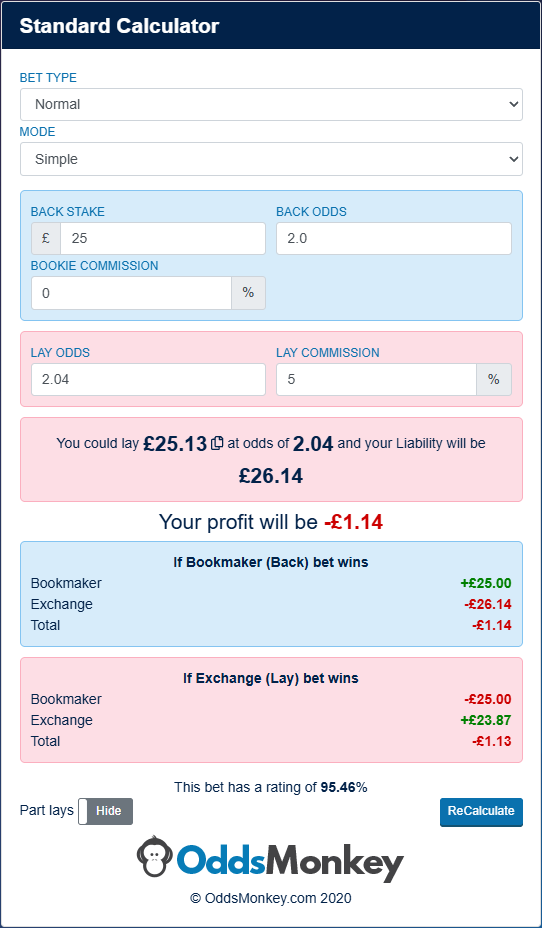
The calculator tells us to:
- Back £25 at 2.00 with the bookmaker
- Lay £25.13 at 2.04 on the exchange
- Have £26.14 available to cover the lay liability
The calculator shows a loss of approximately £1.14 whichever side wins. That’s the small cost we’re accepting in order to unlock the £25 free bet.
Step 4: Place Both Qualifying Bets
You can now place the £25 back bet with the bookmaker and the £25.13 lay bet on the exchange.
Always check that the odds haven’t changed before confirming either bet. If the lay odds move significantly after you’ve placed the bookmaker bet, your calculated lay stake may no longer be correct.
Once both bets are matched, you don’t need to worry about which team or player actually wins. One side of the matched bet will win and the other will lose.
After the promotion requirements have been satisfied, the bookmaker credits your £25 free bet.
Step 5: Find a Bet for the £25 Free Bet
Now the objective changes.
With a stake-not-returned free bet, higher odds can allow you to retain a greater proportion of its value, provided you can find reasonably close lay odds and have enough money available to cover the liability.
For this example, we’ve found:
- Free bet: £25
- Back odds: 6.00
- Lay odds: 6.20
- Exchange commission: 5%
Step 6: Calculate the Free-Bet Lay Stake
This time, select Free Bet (SNR) in the calculator.
Calculating the £25 SNR free bet
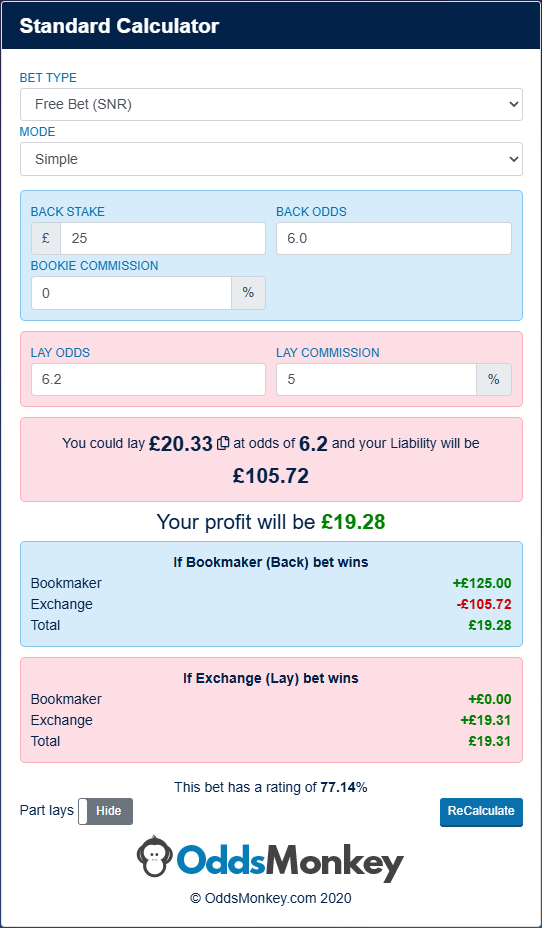
The calculator tells us to lay £20.33 at odds of 6.20.
Because we’re laying at relatively high odds, the required liability is much larger: £105.72.
This is why your exchange balance matters when matched betting. The £105.72 isn’t an additional cost — it’s money temporarily held by the exchange to cover the potential loss on your lay bet.
Step 7: Place the Free Bet and Lay Bet
Place the £25 free bet at 6.00 with the bookmaker and the £20.33 lay bet at 6.20 on the exchange.
The calculator shows how the hedge works:
- If the bookmaker bet wins: approximately £19.28 profit
- If the exchange bet wins: approximately £19.31 profit
So although the sporting result determines which bet wins, it makes very little difference to the amount you receive.
Step 8: Calculate Your Overall Profit
We’ve now completed the entire promotion.
Our qualifying bet cost approximately £1.14, while the £25 free bet generated at least £19.28.
Therefore:
- Free-bet profit: £19.28
- Qualifying loss: £1.14
- Overall profit: £19.28 – £1.14 = £18.14
That’s how matched betting turns a bookmaker promotion into cash without needing to predict the sporting result.
The exact return will vary with the odds you find, exchange commission and the terms of the promotion. The better your back and lay odds match, the more of the promotion’s value you can generally retain.
Other Types of Matched Betting Offers
Our worked example uses a stake not returned (SNR) free bet, which is one of the most common types of bookmaker promotion. However, it’s not the only offer that can be used for matched betting.
Other promotions can include:
- Stake returned free bets — where the free-bet stake is included in your returns if the bet wins.
- Bet refunds — where your stake is refunded as cash or a free bet if certain conditions are met.
- Bet boosts — enhanced odds that can sometimes create an opportunity to hedge for a profit.
- Reload offers — promotions offered to existing customers rather than only when opening an account.
The calculations and steps can differ depending on the promotion, so you shouldn’t automatically use the SNR method shown in our example for every offer.
This is another reason a matched betting service can be useful: the offer instructions and calculator can be adapted to the particular promotion you’re completing.
Why the Odds Matter in Matched Betting
The odds you choose affect how much you lose when qualifying, how much money you need at the exchange and how efficiently you can convert a free bet.
For qualifying bets, you generally want the bookmaker back odds and exchange lay odds to be as close as possible. Backing Tottenham at 3.20 and laying at 3.30, for example, will produce a much smaller qualifying loss than backing at 3.20 and laying at 4.00.
Lay odds also affect your liability. The higher the lay odds, the more money you need available at the exchange to cover the bet. This doesn’t mean you’re losing more money — but more of your bankroll will be required.
Free bets work slightly differently. With a stake not returned (SNR) free bet, higher odds can help you convert a greater percentage of its value into cash. This is because the free-bet stake isn’t returned when you win, so at low odds it represents a relatively large proportion of the potential payout. As the odds increase, that missing stake becomes less significant.
Higher odds can therefore be useful when converting an SNR free bet. However, you still need to find closely matched lay odds — otherwise the difference between the back and lay prices can reduce your profit.
How Much Money Do You Need for Matched Betting?
You don’t need a huge bankroll to start matched betting, but you do need enough money to fund both sides of your bets.
It’s important to distinguish between money required and money actually lost. Your bookmaker stake and exchange liability may both be tied up while a bet is active, but most of that money is returned once the bets have settled.
How Much Do You Need to Start?
As a rough guide, around £150–£200 can be enough to get started with smaller matched betting offers, although some bets will require considerably more money to cover the exchange liability.
For example, our £25 free-bet example required £105.72 of exchange liability. That money wasn’t lost — it simply needed to be available at the exchange to cover the lay bet.
The amount you need will vary depending on the stakes and odds involved. Higher lay odds generally require more liability, so some offers can temporarily require a much larger balance.
Does a Larger Bankroll Help?
Having more money available gives you greater flexibility rather than necessarily increasing the amount you risk.
A larger bankroll can allow you to:
- Complete several promotions at the same time
- Cover higher exchange liabilities
- Start new offers without waiting for previous bets to settle
In practice, cash flow is often more important than the amount you’re actually losing. The more money you have available, the easier it becomes to move between offers without waiting for funds to be released.
How Much Can You Make From Matched Betting?
There’s no fixed amount you can make from matched betting. Your returns depend on the number and value of the promotions available and how efficiently you complete them.
New customers generally have the most opportunities because bookmakers often reserve their best promotions for sign-ups. Once these welcome offers have been completed, you’ll become more reliant on reload offers and other promotions for existing customers, which tend to be less predictable.
It’s also important to remember that the headline value of a promotion isn’t pure profit. Qualifying losses, exchange commission and the back and lay odds all affect how much you ultimately retain.
Matched betting is therefore better viewed as a way to extract value from bookmaker promotions than as a source of guaranteed monthly income.
Is Matched Betting Risk-Free?
Matched betting is often described as risk-free because your back and lay bets are designed to cover the possible outcomes of an event. If both bets are placed correctly, you don’t need to predict what will happen to make a profit from the promotion.
However, that doesn’t mean matched betting is completely without risk. Most of the potential problems come from how the bets are placed rather than the sporting result itself.
Common mistakes and risks include:
- Odds changing between placing your back and lay bets, leaving you with a less favourable match.
- An unmatched or partially matched lay bet, meaning you haven’t fully covered the bookmaker bet.
- Entering the wrong figures into the calculator or using the wrong calculation type.
- Backing and laying different markets, such as accidentally using different handicaps or match outcomes.
- Misunderstanding the promotion terms and failing to qualify for the expected free bet or reward.
There can also be unusual situations such as bets being voided or markets settling differently between a bookmaker and exchange.
Matched betting therefore removes much of the risk associated with predicting sporting results, but careful execution still matters. Always check the market, odds, stakes and promotion terms before confirming your bets.
Is Matched Betting Worth It?
Matched betting can be worthwhile if you have access to bookmaker promotions and are prepared to spend some time finding and placing the required bets.
Its biggest advantage is that the value comes from the promotion rather than your ability to predict sporting results. However, it requires a bankroll, involves some administration and becomes less predictable once you’ve worked through the most valuable welcome offers.
For beginners, straightforward welcome offers are the easiest place to start. A matched betting service can also make finding suitable odds and calculating the required lay stakes considerably easier.
Matched betting isn’t guaranteed income, but it can provide a systematic way to extract value from bookmaker promotions when suitable opportunities are available.
Matched Betting FAQ
Is Matched Betting Legal?
Yes. Matched betting involves placing ordinary bets with bookmakers and betting exchanges. In the UK, you should use gambling operators that are appropriately licensed for the services they provide.
You still need to comply with each operator’s terms and the conditions attached to any promotion you’re using.
Is Matched Betting Gambling?
The individual transactions are still bets, but matched betting works differently from conventional gambling because you’re deliberately placing opposing bets rather than trying to predict the sporting result.
The objective is to use the bookmaker promotion while hedging the outcome, although execution mistakes and other practical risks can still result in losses.
Do You Pay Tax on Matched Betting Profits in the UK?
For an ordinary individual bettor in the UK, gambling winnings are generally not subject to income tax. UK gambling duties are instead primarily imposed on gambling operators.
Tax treatment can depend on individual circumstances, however, so seek professional tax advice if you’re unsure about your situation.
Do You Need a Matched Betting Service?
No. You can find offers, compare back and lay odds and calculate your stakes manually.
However, a matched betting service can make the process considerably easier by providing offer guides, oddsmatching software and calculators. This can save time and reduce the chance of making calculation or execution errors.
Do You Need a Betting Exchange for Matched Betting?
Not necessarily. It’s possible to hedge some promotions using bets with different bookmakers, but a betting exchange is normally the most practical option because it allows you to lay an outcome directly.
This makes it much easier to create the opposing side of a matched bet.
Does Matched Betting Work on a Phone?
Yes. Bookmaker and betting exchange apps make it possible to place matched bets from a phone, while many matched betting tools can also be accessed through a mobile browser.
You still need to check your odds, stakes and lay liability carefully before confirming each bet.
What Happens If My Lay Bet Isn’t Fully Matched?
If your lay bet is only partially matched, part of your bookmaker bet remains exposed to the sporting result.
Check how much of the lay bet has actually been matched before assuming your position is covered. You may need to place another lay bet for the remaining amount and recalculate your position if the available odds have changed.
Can Bookmakers Restrict You for Matched Betting?
Yes. Bookmakers can restrict your stakes or stop offering you promotions.
However, they can’t normally see that you’ve hedged a bet on a separate betting exchange. Restrictions are more likely to result from the betting activity they can see, such as repeatedly using promotions or displaying betting patterns they consider commercially unattractive.
If an account is restricted, you may simply have fewer matched betting opportunities with that bookmaker.
Can You Claim the Same Welcome Offer More Than Once?
No. New-customer promotions are normally limited to eligible customers claiming them once. Attempting to open additional accounts to claim the same welcome offer can breach the bookmaker’s promotional terms and result in the bonus or associated winnings being withheld.
Always check the specific terms of the promotion before taking part.
What If Two Matched Bettors Live in the Same Household?
Bookmaker promotional terms often place restrictions on multiple claims from the same household, address or other shared details.
Don’t assume that two people living together can both claim the same welcome offer. Check the promotion’s eligibility terms first.
What Is Matched Betting Without Free Bets?
The basic back-and-lay technique can be used without a free bet, but there needs to be another source of value for it to produce a profit.
For example, if bookmaker odds are sufficiently higher than the opposing odds available elsewhere, you may be able to cover the outcomes for a profit. This is arbitrage betting rather than conventional matched betting.

- Who Are The Top Online Casino Software Providers? - October 5, 2026
- How October Matchups Can Change the Way You Bet on NFL Games - October 5, 2026
- How to Bet on the 2026 Breeders’ Cup: A Wagering Guide - October 5, 2026