
Free bets and promotions are commonly advertised on various platforms, including internet banners, TV, and radio. While they may not be as lucrative as they used to be, they still offer players a chance to explore new sportsbooks, try out different games or sports, and potentially generate winnings with a relatively low deposit.
In this article, I will examine the results of free bets and demonstrate the value they provide to players. Please note that these results are based on simulations using specific free bet terms and conditions, and there is no guarantee that such promotions will increase a player’s profitability.
The exact structure of free bet promotions varies between sportsbooks and countries, but the concepts explained below remain widely applicable.
Article Contents
Simulating The Value Of Free Bets
To illustrate the value in free bets I have collected a large set (of 9,242) odds & results from bookmakers. Here’s some points to note about this sample:
- Odds were available pre-race at UK bookies
- All bets assume a £25 stake
- Odds ranged from 8.0 to 20.0 (as this retains more value)
- A simple selection method (based on recent form) was used to choose the bets
Using this sample of 9,242 bets, I’ve simulated the profitability using different types of free bets.
Stake Not Returned (SNR)
SNR bets are generally offered when you first sign up to a bookmaker. Any winnings you make on the free bet are returned to your account, but the free stake itself is not re-credited.
e.g. if you placed a £25 free bet on a horse at 3.0 and the horse wins you return ((3.0 * £25) – £25) = £50 as opposed to the normal £75 return you would from a regular bet.
Here are some key points about SNR bets:
- When you sign up you may need to enter a code to let the sportsbook know that you want the free bet
- Before you obtain your free bet you’ll need to deposit your own money and place one “qualifying bet” of (typically) an equal amount at the minimum odds stated (e.g. over 2.0) before the bet is credited. This must be your first ever bet.
- SNR bets don’t normally carry a wagering requirement on winnings made from the free bet; this means you can withdraw it straight away
- It doesn’t matter if you win or lose your initial qualifying bet using your own funds — the free bet is still credited
- You usually have to risk the full SNR stake on one outcome (no splitting the bet up)
To begin verifying the profitability of SNR free bets, I used my data set to simulate the results of placing random qualifying bets. Remember that this does not (yet) involve any free bet.
Qualifying bets placed on a random half of the sample (4621 bets)
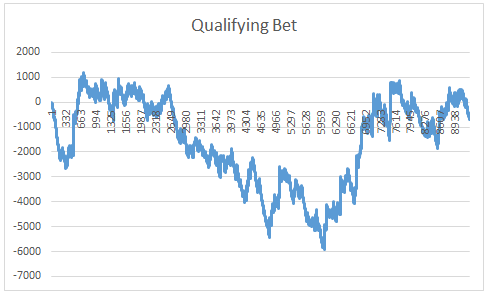
The trend is somewhat inconsistent. But given the large bet size, the result is a relatively small loss of -£675. This is a loss of £0.14 per every £25 bet.
Next up are the simulated results of the SNR bet, which produces a consistently profitable result.
The SNR bets placed on the remaining half of the sample (4621 bets)
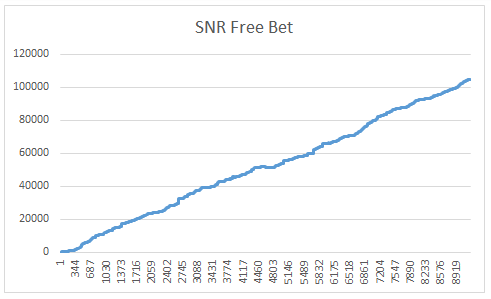
The SNR bet simulation does not fluctuate in the negative direction due to the fact that, unlike with the qualifying bet, the player is not risking their own money. This means the outcome of each individual bet is either:
-
- SNR Bet wins: the player keeps the winnings
- SNR Bet loses: the player’s real money balance is unchanged.
So, only the qualifying bet can lose the player their own money with an SNR promotion.
Result
The SNR bets on their own achieved a profit of +£105,050, equating to £22.73 per £25 SNR bet staked. If we include the qualifying bet in the calculation then we have:
(-£675 + £105,050) = £104,375, equating to an average profit of £22.58 per £25 SNR bet.
Bet Refund
Bet Refunds are sometimes available as a signup promotion and are frequently given as bonuses to existing customers. A Bet Refund involves placing a bet with your own money, except you’ll have your money re-credited in cash, or bonus funds, if you lose.
e.g. if you placed a £25 bet on a horse at 5.0 and the horse loses you’ll be re-credited £25 in cash OR as a free bet, opposed to simply losing your stake.
Here are some key points about Bet Refunds:
- You may need to enter a code to let the sportsbook know that you want the refunded bet
- Before you claim a refund (on the website or via email) you’ll need to place a bet at the minimum odds stated (e.g. over 2.0)
- It is similar to the SNR bet in that if you lose the “qualifying” bet of your own money you’re not necessarily out of pocket yet
- Bet Refunds are often credited as an SNR bet, which makes it less valuable than if it were credited as withdrawable cash. This is because you won’t receive the stake back on any winnings from SNR free bets. If you’re unsure on how this works then read back the previous section on SNR bets.
To begin verifying the profitability of Bet Refunds, I used my data set to simulate the results of placing random qualifying bets. Remember that no refund has been applied yet.
Qualifying bets on half of the sample (4621 bets)
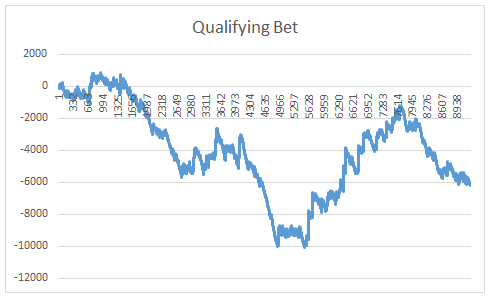
You may observe that our random simulation is quite different to that of the qualifying bets on the SNR’s despite it having the exact same number of bets. I have purposely selected random bets in order to underline the impact of variance in results. Even on substantial sets of data the results can produce hugely different results across different simulations. In this case the simulation has lost a lot more than before.
The qualifying bets have performed more realistically this time, and lost a total of -£6,025. This is an average loss of £1.30 per every £25 bet.
However, Bet Refunds have a huge positive impact to such negative results, as per the following graph. It shows the total amount credited to player accounts whenever the qualifying bet loses.
Total credited from Bet Refunds (4621 bets)
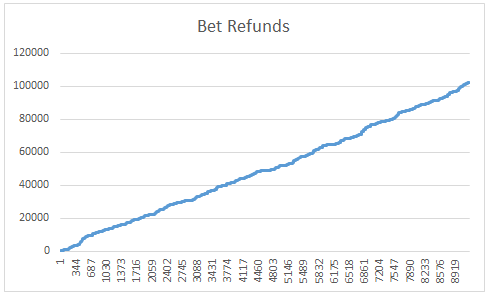
The total running credit received by the players’ accounts grows steadily in the positive direction, trivialising the losses incurred by placing the qualifying stakes. The refunds totalled +£104,075 in this simulation.
Result
By combining the qualifying bet in the profit calculation, the result is -£6,025 + £104,075 = £98,050 = £21.22 profit per every £25 bet refund.
NOTE: If the refund is credited as an SNR bet then the expected profit will be less because:
- The stake is not returned in your free bet, meaning only winnings are retained.
- You’ll be placing another stake at the bookmaker, thereby betting against their margins once more.
Matched Deposit Bonuses (Bonus Funds)
Matched Deposit Bonuses (also known as Bonus Funds or Bonus Balance) are normally offered as a signup bonus. With this promotion you’re credited additional bonus funds after you first make a qualifying deposit. Unlike SNR bets or Bet Refunds, the bonus funds behave much like real money because your stake is returned with any winnings.
e.g. if you deposit £25 and are eligible for a 100% matched deposit bonus, then your balance will increase to £50 prior to betting. Before you withdraw you’ll need to meet a minimum rollover requirement.
Here are some key points about Matched Deposit Bonuses:
- You may need to enter a code to let the sportsbook know that you want the bonus funds added to your account upon depositing
- Before you can withdraw the money you’ll need to place several bets at the minimum odds stated (e.g. over 2.0)
- Matched Deposit Bonuses often carry hefty rollover requirements before a withdrawal is allowed. Unfortunately in rare cases this can result in the promotion leaving the player worse off than betting without the bonus
- If you bust-out your balance then this is the end of the promotion for you. Thankfully the rollover requirements aren’t normally still tied to your next deposit
- Bonus funds behave like normal cash while betting, meaning the stake you place is included in any returns
- Your rollover may be limited to a maximum stake amount as well as minimum odds.
Due to various restrictions on bonus funds, it’s a little more difficult to simulate the outcome without making some generalisations. To begin I have demonstrated how a matched deposit bonus impacts your profitability by assuming 1x wagering requirements apply.
NOTE: this example is theoretical and for illustration purposes only. In reality you’ll need to meet strict wagering requirements before making a withdrawal.
Matched deposit bonuses, placed on a random half of the sample (4621 bets)
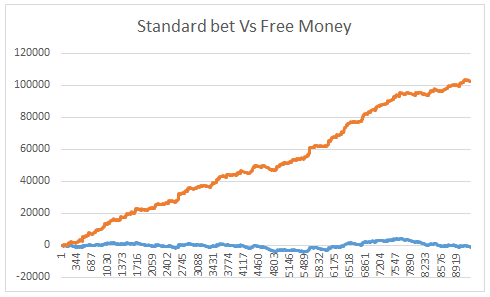
The blue line shows how £25 stakes, without a bonus balance, fair against those boosted with an additional £25. I have assumed that the full balance of £50 has been bet in one go and that no further bets are required to meet the rollover requirement.
Effectively the graph demonstrates a “double your winnings” scenario, where all losing bets still lose the full £25 stake as per normal, while all winning bets have twice as much stake at no further risk to the player.
Result
The Matched Deposit Bonus produced a profit of +£102,800, which equates to £22.24 per £25 bonus.
However, this gives the absolute best case scenario as it only assumes a 1x wagering requirement on the bonus funds. You can feasibly find an offer with a 1x wagering requirement on smaller promotions such as a “£5 free spin” at an online casino. However, in many cases the wagering requirement is likely to be higher (e.g. 10x (deposit + bonus)).
The example serves to illustrate how bonus funds can give a huge positive edge to the bettor, but it’s important to note that a higher rollover will erode the potential profit according to the bookmaker’s edge.In the next section I explore the impact of Rollover Requirements, as it’s crucial for assessing the value of free bets.
Rollover Requirements
Bookmakers have an advantage, which is known as their “edge” or “overround“. Bettors need to consider this when they claim free bets and promotions, especially while placing qualifying bets.
Generally the overround is negligible for SNR free bets, as the player only bets against the bookmaker with their own money during the qualifier. The rollover requirement for the SNR bet is typically only “1x bonus” on. In other words, it doesn’t have to be rolled over once it has been placed. Therefore the expected loss from the qualifier tends to be outweighed by the potential value from the SNR bet.
On high rollover promotions more consideration has to be given to what losses you expect to incur from placing your bets against the bookmaker. If we assume that bookmakers have a 5% profit margin, and this is the average for all bets made, then you can produce an estimate of the expected loss during any rollover of bets.
e.g. A Matched Deposit Bonus carries a rollover requirement of 10 x (deposit + bonus). A £25 bonus is added on top of £25 deposited, making a £50 total start balance.
Here’s how to estimate the potential loss while meeting the rollover of this promotion:
- Rollover requirement =10 x (£25 + £25) = £500
- Expected loss = £500 * (-5%) = -£25
- Expected account balance by the end of the rollover: £0 (break-even)
Based on this estimate, the example promotion doesn’t give any edge to the player! However, the manner in which you bet through the bonus has a huge impact on the results.
High vs Low Stakes
Here’s the deal: it’s optimal to bet high stakes during a rollover requirement. Simulations back this theory up.
Below are the simulated profits from this £500 rollover, assuming a consistent bet size is maintained throughout:
- £50 stakes: ~£16.72
- £25 stakes: ~£14.28
- £10 stakes: ~£10.63
- £5 stakes: ~£7.90
- £1 stakes: ~£3.68
Mathematically the expected profit is higher by taking more risk on the rollover. Large stakes increase the amount of the bonus funds you’ll retain (on average), but also increase the chance of busting out. Low stakes reduce the amount of the bonus funds you’ll retain (on average), but decrease the chance of busting out.
Additionally, betting small wastes a lot of time.
Final Points
My simulations show that in the long-term the players collectively profit from free bets — unless the wagering requirements or promotion terms are particularly restrictive. However, in general, the intention of free bets is to draw in customers, as part of the bookmaker’s marketing strategy. So they tend to offer great value.
Here are some final points to take away:
- You can never retain more value from a promotion than the money on offer. e.g. a £25 free bet never holds value more to the player than £25. Even if the bookmaker edge is 0%.
- To maximise what you make from free bets:
- Consider keeping stakes high: it’s risky but it raises the potential amount of profit per free bet.
- Search for odds that you deem to be value: taking poor odds will lower your margins. Try to at least identify selections with odds close to those offered by the betting exchanges.
- Use high odds: whilst this increases variance (swings in results), the return you get from your free bets is higher than if you use low odds. This is one reason why my test results retained around 84% of the £25 free stakes offered by the three scenarios — a very good outcome.
Looking for the latest welcome offers? Browse our Free Bets & Promotions page to compare current sportsbook promotions.

- AsianConnect Review|Safe Access To Bookmakers & Exchanges [2026] - October 11, 2026
- Popular Football Betting Markets Explained | Soccer Bet Types - October 11, 2026
- Betting Bankroll Management & Staking Plans Guide - October 10, 2026