
Horse racing odds rarely move at random. As more information becomes available and more money enters the market, prices constantly adjust to reflect the betting public’s collective opinion.
This opinion is most effectively gauged on betting exchanges, where backers and layers express their views on every possible outcome.
As a race draws closer, the market gradually moves towards a consensus, with prices generally becoming more accurate through the phenomenon known as the “Wisdom of Crowds.” Understanding why these movements occur can help bettors interpret the market rather than simply reacting to it.
Below, I explore the main factors that shape pre-race horse racing odds, both consciously and unconsciously.
Article Contents
1. Form & Statistics
Many bettors are heavily influenced by the available facts surrounding an upcoming horse race. Some of the most important factors include:
- Form: The recent performance and form of the horse is one of the most significant influences on its odds. If a horse has been performing well in recent races, it is likely to attract more backers and its price may shorten.
- Horse attributes: Several characteristics can affect how bettors assess a horse’s chances:
- Age: Younger horses may have greater potential to improve, while older horses may have more established form.
- Sex: Colts, geldings, fillies and mares may perform differently under certain race conditions, which can influence the market.
- Pedigree: A horse’s pedigree, or family tree, can provide clues about its likely ability, preferred distance and suitability for different surfaces.
- Distance: Some horses are better suited to particular race distances. A return to a preferred trip may result in stronger market support.
- Running style: Front-runners, prominent racers and hold-up horses can be affected differently by the expected pace and shape of a race.
- Weight: The weight carried by a horse, particularly in handicaps, can affect its expected performance and therefore its odds.
- Health and fitness: A horse’s fitness, preparation and any known injury concerns can have a major impact on confidence in its chances.
- Race type: Different races, including Group races, handicaps and maidens, present different challenges. Horses may perform better or worse depending on the quality of the opposition and the conditions of the race.
- Jockey & Trainer: The reputation, recent form and experience of the jockey and trainer can influence market confidence. A horse ridden by a leading jockey or trained by a successful stable may attract additional support.
- Weather and track conditions: The track conditions, including the going, weather and visibility, can affect how well individual horses are expected to perform.
Bettors analyse these factors and consciously or unconsciously assign weightings to them based on their perceived importance. Some rely on straightforward methods such as reviewing racecards and recent form, while others analyse thousands of data points using spreadsheets, databases and more complex modelling techniques.
Best websites for horse racing statistics.
2. Outside Influences
Outside influences such as commentators, media coverage, tipsters and wider public sentiment can also affect pre-race price movements.
These influences shape how the betting public perceives a particular horse’s chances of winning and may cause its odds to change even when no new objective information has emerged.
Commentators, for example, may highlight a horse’s recent form, physical condition or suitability for the race. If a respected commentator speaks positively about a runner, it can increase confidence in that horse and cause its odds to shorten.
Similarly, media coverage can influence market opinion. If a horse receives significant attention in a high-profile publication, television broadcast or online discussion, it may attract additional betting interest.
Public sentiment and market liquidity also play an important role. A surge of money on a particular horse can cause its odds to shorten, especially when large numbers of bettors follow the recommendations of a highly rated horse racing tipster.
Conversely, if there is little demand for a horse at its current price, its odds may drift as traders and sportsbooks attempt to attract more bets.
Overall, outside influences can change the market’s perception of a horse’s chances and contribute to significant pre-race price movements.
3. Bookmakers
In the lead-up to a race, betting activity at sportsbooks can cause significant price movements.
Bookmakers are responsible for setting the initial pre-race odds for horse racing markets. They consider factors such as past performance, form, jockey, trainer, track conditions and any other relevant information.
These early prices establish an initial view of the race and can influence the betting public’s expectations. However, they remain subject to potentially large fluctuations as new information emerges and money enters the market.
Bookmakers adjust their odds in response to betting activity and changes elsewhere in the market. If a significant amount of money is wagered on a particular horse, its odds may be shortened to reduce the bookmaker’s potential liability.
If there is little interest in a horse, its price may be increased to encourage more betting.
Bookmakers can also use hedging strategies to manage their risk, such as backing horses with other bookmakers or placing lay bets on a betting exchange. These actions can contribute to further movement across the wider market.
Learn how bookmakers set their odds.
4. Human Nature
Human behaviour plays a significant role in shaping horse racing markets. Bettors do not always make decisions using purely objective information, and emotional or psychological factors can influence which horses attract support.
Some of the most common human factors affecting horse racing odds include:
- Pre-race observations: A horse’s appearance in the parade ring can influence perceptions of its chances. Its gait, temperament, sweating or restlessness may increase or reduce market confidence, even when these observations are open to interpretation.
- Superstition and random choices: Horses are sometimes selected for reasons such as their name, colour, number or a bettor’s gut feeling, without any sound reasoning behind the decision.
- Herd mentality: Once a market begins moving in one direction, other bettors may follow the trend simply because they assume the original movement was caused by informed money.
- Fear of missing out: When a horse’s price starts shortening quickly, bettors may rush to back it before the odds fall further. This can accelerate the movement even when little new information is available.
- Biases: Cognitive biases such as recency bias and the favourite-longshot bias can affect how bettors interpret information and estimate a horse’s chances.
Learn more about biases in sports betting.
5. Non-Runners
Non-runners can have a significant impact on pre-race horse racing odds. A non-runner is a horse that was entered into a race but is subsequently withdrawn before it takes place.
Common reasons include injury, illness or unsuitable track conditions.
When a horse is withdrawn, the chances of the remaining runners increase because there is now one fewer competitor in the race. As a result, the odds of the remaining horses may shorten to reflect their improved probability of winning.
The size of the adjustment depends on the quality of the withdrawn horse, the number of remaining runners and the specific conditions of the race.
If the non-runner was considered an outsider, the market may barely move. However, the odds may shift dramatically if a favourite or another leading contender is withdrawn.
The impact of a favourite becoming a non-runner in a race starting at 13:10.
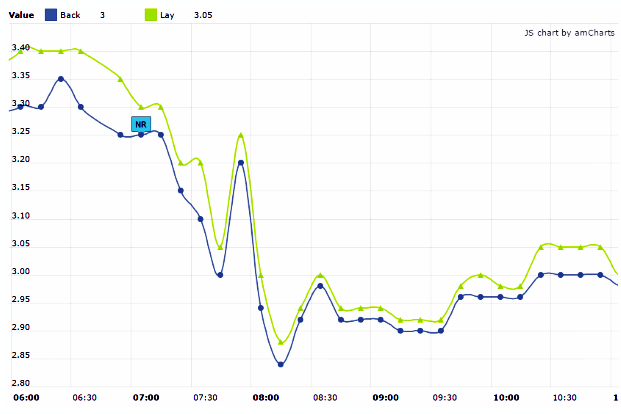
- “NR” shows the point at which our sources first reported the non-runner at 07:05:29.
- By 07:40, the odds had moved from 3.25 down to 3.0, representing an 8% decrease.
- The odds then drifted to 3.2 by 07:50 before reaching a low of 2.84 at 08:20, a 12.6% move from the original price.
Market volatility increases sharply after a significant non-runner because bettors must quickly reassess the chances of every remaining horse.
The sudden change can create a temporary difference of opinion across the market. In this example, the volatility lasted for just over an hour before prices stabilised and the market reached a new consensus.
It is also important to understand that betting sites may apply different rules to non-runners. Most will refund pre-race stakes placed on a withdrawn horse by treating the bet as void.
Ante-post betting operates differently. Unless the market is advertised as “non-runner no bet” or “NRNB”, a bettor will usually lose their stake if the selected horse does not participate.
To learn more about how collective market opinion shapes betting odds, read my guide to the Wisdom of Crowds theory in betting.

- Rugby Betting Guide | How To Bet On Rugby In 2026 - October 25, 2026
- What’s A Bet Broker? How Do Betting Brokers Work? - October 25, 2026
- Can Sports Betting Courses Be Trusted? Should I Pay For One? - October 25, 2026